

Private banks recruit thousands of candidates every year for customer service, sales, operations, relationship management, and back-office roles. Unlike government banking recruitment, private bank hiring is conducted throughout the year based on business requirements. This provides excellent opportunities for fresh graduates and job seekers looking to build a career in the banking sector.
However, many candidates are unsure about what happens after they apply for a banking job. Understanding the recruitment process can help you prepare effectively and improve your chances of getting selected. From aptitude assessments to personal interviews and final onboarding, every stage is designed to evaluate whether a candidate is ready to work in a customer-focused banking environment.
In this article, we’ll explain the complete private bank recruitment process, including the aptitude test, interview rounds, and final selection.
Understanding the Private Bank Recruitment Process
Although every private bank may have slight variations in its hiring process, most banks follow a structured recruitment workflow to identify suitable candidates.
Step 1: Online Application or Candidate Registration
The recruitment journey begins when candidates apply through:
- Bank career portals
- Banking placement organizations
- Job portals
- Campus recruitment drives
- Professional networking platforms
Applicants are required to submit their resume along with educational details and contact information. Recruiters review the applications to shortlist candidates who meet the eligibility criteria for the available position.
Keeping your resume updated and professionally formatted can significantly improve your chances of getting shortlisted.
Step 2: Resume Screening
After receiving applications, recruiters evaluate resumes based on:
- Educational qualifications
- Communication abilities
- Relevant certifications
- Internship or work experience
- Computer proficiency
- Overall presentation
Recruiters generally look for candidates whose profiles closely match the job requirements rather than simply selecting applicants with the highest academic scores.
Step 3: Aptitude Assessment
Many private banks conduct an aptitude assessment before scheduling interviews, especially for entry-level positions.
The aptitude test evaluates a candidate’s basic analytical and problem-solving abilities.
Common topics include:
- Quantitative Aptitude
- Logical Reasoning
- Verbal Ability
- Basic English
- Data Interpretation
- Numerical Ability
The level of difficulty is usually moderate and focuses on assessing whether candidates can handle routine banking tasks effectively.
Practising aptitude questions regularly helps improve both speed and accuracy.
Step 4: Communication Assessment
Since banking is a customer-facing industry, communication plays a major role during recruitment.
Recruiters evaluate:
- Spoken English
- Confidence
- Pronunciation
- Listening skills
- Professional etiquette
- Ability to explain concepts clearly
Candidates who communicate confidently while maintaining a positive attitude often leave a strong first impression.
Interview Process and Final Selection in Private Bank Recruitment
After successfully clearing the initial screening stages, shortlisted candidates proceed to one or more interview rounds.
HR Interview
The Human Resources interview focuses on understanding the candidate’s personality, career goals, and overall suitability for the organisation.
Some commonly asked questions include:
- Tell us about yourself.
- Why do you want to work in banking?
- Why do you want to join our bank?
- What are your strengths?
- Where do you see yourself in five years?
- Are you willing to relocate?
Recruiters observe not only your answers but also your confidence, attitude, professionalism, and body language.
Technical or Banking Interview
Depending on the role, candidates may attend a technical interview to assess their banking knowledge.
Interviewers may ask questions about:
- Savings and Current Accounts
- KYC Procedures
- Loans
- Fixed Deposits
- Digital Banking
- Banking Products
- Customer Service
- Basic Financial Concepts
Freshers are not expected to know everything, but having a solid understanding of banking fundamentals creates a positive impression.
Sales and Customer Interaction Assessment
For customer-facing roles such as Relationship Officer or Sales Executive, recruiters also assess sales aptitude.
Candidates may be evaluated on their ability to:
- Understand customer requirements
- Recommend suitable banking products
- Handle objections
- Build customer relationships
- Demonstrate persuasive communication
This stage helps banks identify candidates who can contribute to business growth while maintaining excellent customer service.
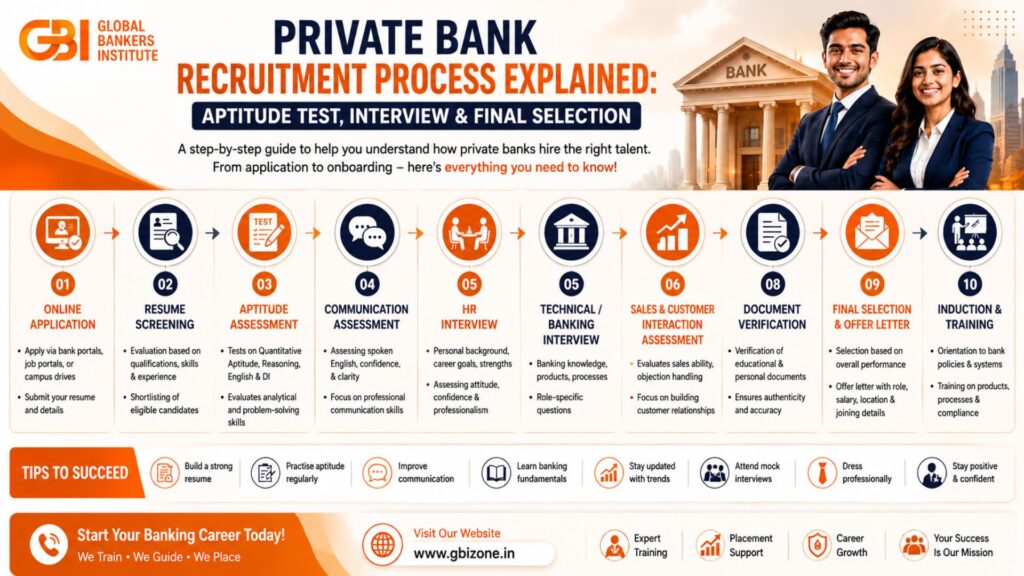
Document Verification
Candidates who successfully complete the interview process are asked to submit supporting documents for verification.
Typically required documents include:
- Graduation Certificates
- Mark Sheets
- Aadhaar Card
- PAN Card
- Address Proof
- Passport-size Photographs
- Updated Resume
Submitting accurate documents ensures a smooth recruitment process and prevents unnecessary delays.
Final Selection and Offer Letter
Once all evaluation stages are completed successfully, selected candidates receive an offer letter.
The offer generally includes:
- Job designation
- Salary package
- Reporting location
- Joining date
- Employment terms
- Training schedule
Candidates should carefully review the offer before accepting it.
Induction and Initial Training
After joining, employees undergo induction training to become familiar with the bank’s policies, systems, products, and customer service standards.
Training commonly includes:
- Banking operations
- Compliance procedures
- Core banking software
- Customer relationship management
- Product knowledge
- Sales processes
- Workplace ethics
This training prepares new employees to confidently handle their responsibilities from day one.
Tips to Successfully Clear the Private Bank Recruitment Process
Candidates can improve their chances of selection by following a few practical strategies:
- Build a professional and well-structured resume.
- Improve communication and presentation skills.
- Practise aptitude tests regularly.
- Learn banking fundamentals before attending interviews.
- Stay updated with current banking trends.
- Participate in mock interviews.
- Dress professionally for interviews.
- Maintain a positive attitude throughout the recruitment process.
Preparation across all these areas helps candidates perform confidently at every stage of recruitment.
Conclusion
The private bank recruitment process is designed to identify candidates who possess the right combination of knowledge, communication skills, professionalism, and customer service aptitude. While the recruitment stages may vary slightly between banks, most follow a structured process that includes application screening, aptitude assessment, interviews, document verification, and onboarding.
For fresh graduates and aspiring banking professionals, proper preparation can make a significant difference in securing a rewarding banking career. At Global Bankers Institute, candidates receive practical banking training, interview preparation, resume guidance, and placement support to become job-ready. You can also explore Bank Jobs without exam in Tamil Nadu or connect with our Private Bank Job Placement Agency in Tamil Nadu to discover suitable opportunities and take the next step toward a successful career in private banking.